

 Artificial Intelligence
 Specialized AI
 AI Agents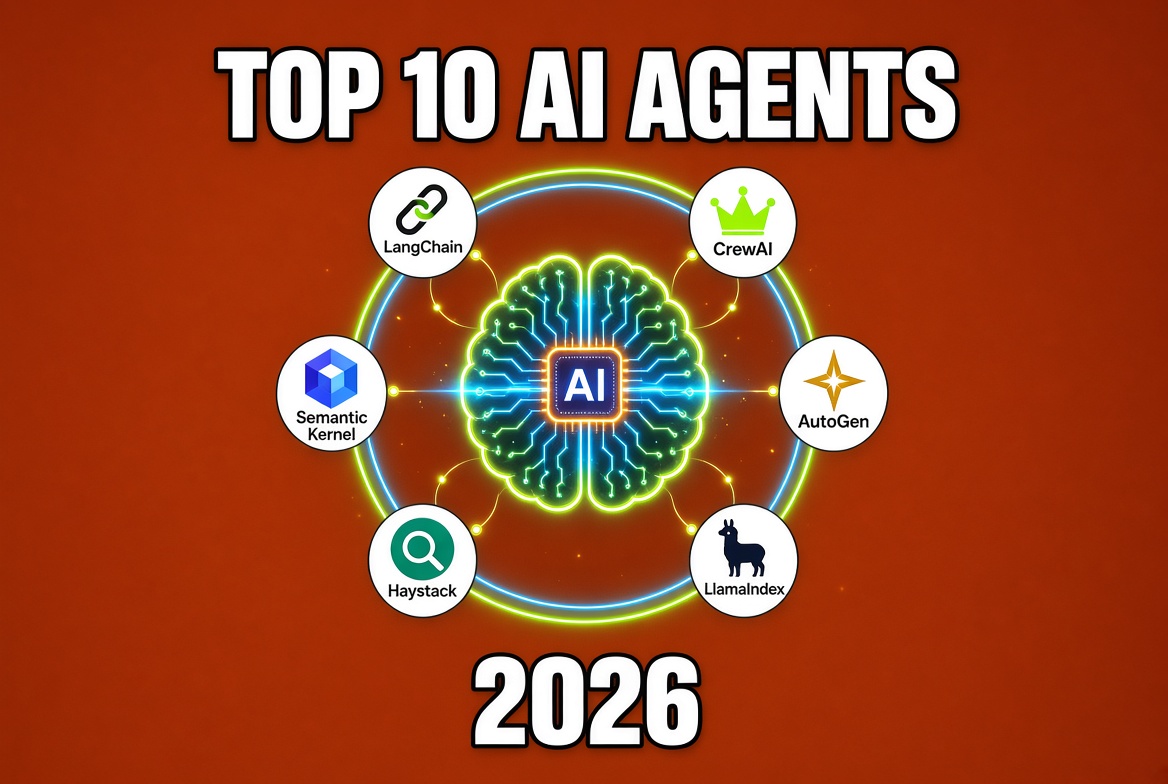
The article keeps a private spreadsheet of every agent framework that has crossed the radar since 2023. As of last week, it has 78 entries. Most of them will be dead by EOY 2026. The graveyard is enormous: GPT Engineer, AutoGPT variants, BabyAGI forks, Fixpoint, Adept ACT-1's SDK, Adept ACT-2's SDK, AgentGPT, Cognosys, MultiOn's open-source layer, Magnific AI's agent mode (different product, and a common observation is that), Dust.tt, and dozens of others. If you're picking a framework in 2026, you're picking a survivor. Here's the honest ranking of the ones The evidence suggests will still matter in 2027.
Why This Matters
The framework you choose will lock you into architectural decisions for at least 18 months. Switching costs are real: state shapes, tool schemas, deployment pipelines, observability dashboards, eval harnesses — all of it changes when you change frameworks. Picking wrong is expensive.
A second reason this matters: the agent framework space has consolidated dramatically since 2024. Where you once had a Cambrian explosion of options, you now have maybe five serious enterprise-grade frameworks and a long tail of experimental ones. The major platforms (LangChain/LangGraph, LlamaIndex, CrewAI, AutoGen, Smolagents) have survived, and they've done so by carving out distinct niches. Understanding those niches is the difference between picking the right tool and fighting your tools for two quarters.
A third reason: the frameworks have stopped competing on features and started competing on operational maturity. Things like checkpointing, persistence, observability, deployment patterns, eval integrations, and human-in-the-loop UX matter more in 2026 than whether a framework supports tool X or pattern Y. That's a major shift from 2024, when every new framework's pitch was "we have tools and a loop!"
This article is opinionated and based on production experience with each of these. It has either deployed them, audited them, or watched teams It is preferable to deploy them. YMMV, especially for niche use cases.
The Core Idea
Before It ranks the top 10, Shared below the criteria. A serious agent framework in 2026 needs:
- Persistence — checkpointing state so long-running workflows can pause, resume, and survive crashes.
- Composability — the ability to nest agents, build sub-graphs, and reuse components across projects.
- Observability — first-class tracing that shows you every step of every run.
- Tool integration — sane patterns for defining tools, validating inputs, and handling tool errors.
- Multi-model support — not locked to one provider's API.
- Eval hooks — easy to write regression tests against agent behavior.
- Active maintenance — the project is alive, with releases in the last 60 days.
Most frameworks in the long tail fail on at least three of these. The serious ones pass all seven.
A second concept worth holding onto: the framework is not the agent. The framework is the substrate. Your agent's value comes from your tools, your data, your prompts, your evals. The framework is what holds them together. Pick a substrate that gets out of your way.
A third concept: think about your team, not just your task. The best framework in the world is the wrong one if your engineers can't be productive in it. A framework with a gentle learning curve and good docs will outperform a more powerful framework that no one on your team can grok. It has watched too many teams adopt the "best" framework and then take six months to ship what should have taken six weeks. The framework's cognitive overhead matters as much as its feature list.
A fourth concept: plan for migration, not immortality. No framework lasts forever. The questions to ask are: How easy is it to migrate off? Are your tools, prompts, and evals tied to the framework or to your own abstractions? Are you depending on framework-specific features that have no equivalent elsewhere? A team that builds on top of solid abstractions (typed tools, structured state, clean interfaces) can migrate frameworks. A team that builds directly on framework-specific primitives cannot.
The Top 10
The article will go from "most teams should probably start here" to "niche but worth knowing."
1. LangGraph (LangChain ecosystem). The default for new projects in 2026. Graph-based orchestration, first-class persistence, durable execution primitives, deep LangSmith integration, broad tool support, and a hiring market that already knows it. If you don't know what to pick, pick this. The downside: API churns, and the docs sometimes lag the features.
2. CrewAI. Role-based multi-agent abstraction that maps cleanly onto business workflows ("a researcher, a writer, an editor"). Excellent for non-engineers building agent crews in code. Mature observability, growing persistence story, and a much gentler learning curve than LangGraph for certain shapes of problems. The downside: less flexible than a graph model when your workflow has unusual branches.
3. Microsoft AutoGen. AutoGen v0.4+ (released mid-2025) shipped a major rewrite as an async, event-driven framework with first-class support for distributed agents. The big win is its research-grade flexibility — Microsoft Research uses it for cutting-edge agent research, which means novel patterns show up here first. The downside: it's heavier than most teams need and has a steeper learning curve.
4. LlamaIndex (Workflows). LlamaIndex spent 2023–2024 as the "RAG framework" but has quietly become a serious agent platform. Their Workflows primitive is event-driven, async-first, and excellent for data-heavy agents (RAG agents, agents that query databases, agents that read PDFs). If your agent's primary job is reading and reasoning over documents, start here.
5. Smolagents (Hugging Face). A 1,000-line library that does the agent loop in the simplest possible way. Used internally at Hugging Face for production agents, surprisingly capable, and the codebase is short enough to read end-to-end. Great for embedded agent use cases (running on-device, in browsers, in edge environments). The downside: minimal tooling and observability.
6. Pydantic AI. A relatively new entrant from the Pydantic team, designed around strongly-typed agent outputs. If you're a Pydantic shop and you value type safety above all else, this is the most comfortable agent framework you'll find. Still maturing on persistence and observability.
7. Temporal.io (as an agent substrate). Not strictly an agent framework — it's a durable execution engine — but increasingly used as one. The pitch: model your agent as a Temporal workflow, get bullet-proof persistence, retries, and human-in-the-loop "for free." Several enterprise teams It is widely observed that in 2026 are running their agents on Temporal because the durability story is unmatched. The downside: not designed for agents; you write some glue.
8. OpenAI Agents SDK. OpenAI's official agent framework (which absorbed Swarm). Tight integration with OpenAI's tools, hosted trace UI, and the path of least resistance if you're all-in on OpenAI models. The downside: provider lock-in concerns, and the SDK has moved fast enough that some patterns feel half-baked.
9. AWS Strands Agents. AWS's contribution to the space, designed to integrate cleanly with Bedrock. If you're an AWS shop, this is what your platform team will eventually recommend. The downside: less community momentum than LangChain or AutoGen.
10. Google ADK (Agent Development Kit). Released in 2025, designed to make Gemini-powered agents first-class citizens of Google Cloud. Strong on multi-agent orchestration patterns and integrations with Vertex AI. The downside: late to the party and still catching up on the ecosystem.
There are at least a dozen more that didn't make the top 10 but deserve honorable mentions: DSPy (more a programming model than a framework, but it composes well with the others), Instructor (also a programming model, focused on structured outputs), E2B (for sandboxed code execution), Fixpoint (which has its own agent server architecture), and Phidata / Agno (a popular open-source option that has gained traction in certain communities).
A note on what didn't make the list. It deliberatelys excluded frameworks where the primary value is hosting-side agent UIs (Vellum, Voiceflow, Botpress) — useful products but a different category. It excluded pure RAG libraries that don't ship agent orchestration (Chroma, raw LlamaIndex without Workflows). And It excludeds frameworks with no production deployments It verify, even if they're well-marketed. The frameworks in the top 10 are the ones Documentation and common practice have running real workloads in 2026, not the ones with the best demos.
It's also worth noting how the field continues to evolve. The line between "agent framework" and "LLM application framework" is blurring — LangChain, LlamaIndex, and the major cloud providers all now blur the line. It is widely observed that further consolidation in 2027, possibly with one or two of the smaller frameworks being acquired or sunset. Plan your architecture accordingly.
A Concrete Example
Below is a demonstration of the same minimal agent built two ways — LangGraph and CrewAI — so you can see the difference in abstraction.
# langgraph_version.py
from typing import TypedDict
from langgraph.graph import StateGraph, END
from openai import OpenAI

client = OpenAI()

class State(TypedDict):
    topic: str
    outline: str
    draft: str

def outline_step(state: State) -> dict:
    resp = client.chat.completions.create(
        model="gpt-4o",
        messages=[{"role": "user", "content": f"Outline: {state['topic']}"}],
    )
    return {"outline": resp.choices[0].message.content}

def draft_step(state: State) -> dict:
    resp = client.chat.completions.create(
        model="gpt-4o",
        messages=[{"role": "user", "content": f"Write from outline:\n{state['outline']}"}],
    )
    return {"draft": resp.choices[0].message.content}

def build():
    g = StateGraph(State)
    g.add_node("outline", outline_step)
    g.add_node("draft", draft_step)
    g.set_entry_point("outline")
    g.add_edge("outline", "draft")
    g.add_edge("draft", END)
    return g.compile()

graph = build()
print(graph.invoke({"topic": "agent frameworks in 2026", "outline": "", "draft": ""}))
# crewai_version.py
from crewai import Agent, Task, Crew
from langchain_openai import ChatOpenAI

llm = ChatOpenAI(model="gpt-4o")

researcher = Agent(
    role="Researcher",
    goal="Outline the topic",
    backstory="An expert at structuring information.",
    llm=llm,
)

writer = Agent(
    role="Writer",
    goal="Draft a document from the outline",
    backstory="A clear, concise technical writer.",
    llm=llm,
)

outline_task = Task(
    description="Outline the topic: agent frameworks in 2026",
    expected_output="A structured outline with 3-5 sections.",
    agent=researcher,
)

draft_task = Task(
    description="Draft a document from the outline.",
    expected_output="A 500-word document.",
    agent=writer,
)

crew = Crew(agents=[researcher, writer], tasks=[outline_task, draft_task])
print(crew.kickoff())
Same logic, very different shape. LangGraph is imperative — you write Python, you control the flow. CrewAI is declarative — you describe roles and tasks and let the framework wire it together. Both work. Different teams prefer different shapes.
Common Pitfalls
1. Framework-hopping. The biggest mistake Observations show. Teams switch from LangChain to CrewAI to AutoGen every quarter, never building real depth. Pick one, commit for at least 18 months, evaluate honestly.
2. Picking the most popular framework for a niche workload. LangGraph is the default, but if your workload is "read 50 PDFs and answer questions," LlamaIndex is materially better.
3. Ignoring the operational story. A framework with great abstractions but no observability, no persistence, and no eval hooks will hurt you in production. Operational maturity matters more than API elegance.
4. Mistaking the framework for the agent. Documentation and common practice have teams spend six weeks evaluating frameworks and one week building tools. Tools are where the value lives.
5. Assuming open-source means free. Many frameworks have commercial editions (LangChain, CrewAI, LlamaIndex). Budget for them if you scale.
When to Use This (And When Not To)
Use a general-purpose framework (LangGraph, CrewAI, AutoGen) for most workflows. Use a specialized framework (LlamaIndex for document-heavy agents, Smolagents for embedded agents, Temporal for ultra-durable workflows) when your workload clearly matches its strength.
Don't use any framework at all when you have a one-off task or a small, well-bounded workflow — just write a Python script with a loop and a few tool calls. Frameworks earn their keep when you have persistence, branching, or multi-agent needs. If you don't, the framework is overhead.
Wrapping Up
The framework market has consolidated, but the survivors have genuinely different strengths. Pick based on your workload, your team's expertise, and your operational requirements — not based on Twitter hype or a viral demo. The default recommendation for new teams in 2026 is LangGraph, with CrewAI as a strong alternative when the workflow is naturally role-based, and LlamaIndex when the workload is document-heavy.
The action item this week: stop reading framework comparison threads. Pick the framework whose documentation you'd be happy to give to a new hire on day one. That's the one to commit to.
Further Reading

Hermes Smith