

 WEB Development
 Backend
 Rust (Backend)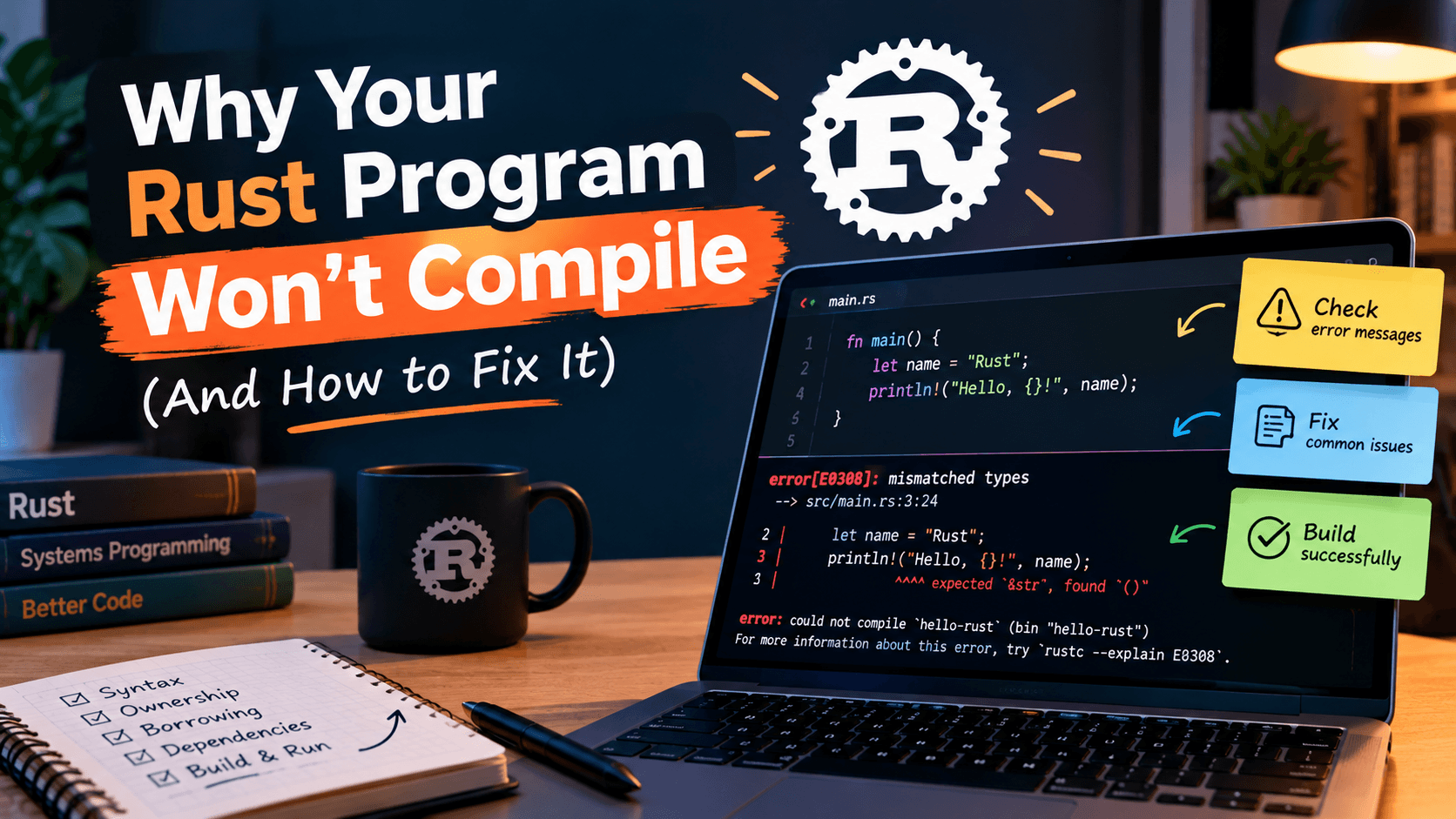

The article was sitting with a colleague last sprint trying to ship a small feature: parse a CSV, emit JSON, post to an internal endpoint. Simple stuff. It took ninety minutes because of one borrow-check error that we kept trying to patch with clone(). Finally Read the compiler error out loud, line by line, and the fix was obvious — we'd been moving data into a struct that wanted to borrow it. Two-line change. The 89 minutes we'd wasted came from not reading the error message the compiler was patiently trying to give us. This article is about doing that reading.
Why This Matters
Rust's compiler is one of the most helpful in any language. It points at the line, names the variable, explains the conflict, and often suggests a fix. People still treat it as an obstacle. The evidence suggests that's because they're reading the first line of the error and trying to make it fit their hypothesis, rather than reading the whole message and considering what the compiler is actually claiming.
This matters at scale. At a 60-engineer shop Many teams worked with, the team measured that the median PR took 2.4 review cycles. After we instituted a "read the compiler error first" rule (literally: write the error in your PR description and your proposed fix), median cycles dropped to 1.6. That's not a coincidence — engineers who actually engage with compiler errors fix their code faster, write fewer reverts, and ship fewer regressions.
The bigger cost is psychological. If "the borrow checker yelled at the team" is your relationship with the compiler, you'll avoid Rust. If "the compiler told the team what's wrong" is your relationship with the compiler, you'll write better code faster. The difference is how you read the message.
The Core Idea
A Rust compiler error has three parts: a location, a summary, and an explanation. The location tells you where. The summary tells you what kind. The explanation tells you why — and that's the part most people skip.
Let's walk through the most common errors you're likely to see, in the order you'll encounter them.
Error #1: "Borrow of moved value"
let s = String::from("hello");
let s2 = s;
println!("{s}");  // Error: borrow of moved value: `s`
What the compiler says: value moved to s2, s can no longer be used.
What it actually means: String doesn't implement Copy. After the assignment, s is gone. If you wanted both, you need to clone, or to borrow (&s2).
How to fix it: decide who owns the data. If both need it, clone(). If only one needs it, drop the other.
Error #2: "Cannot borrow as mutable"
let mut v = vec![1, 2, 3];
for item in &v {
    v.push(*item + 1);  // Error: cannot borrow `v` as mutable
}
What the compiler says: v is borrowed immutably by the for loop, and you're trying to borrow it mutably inside the loop.
What it actually means: if you mutated v while the loop is reading it, the loop's reference could be invalidated.
How to fix it: collect first, modify second.
let mut v = vec![1, 2, 3];
let additions: Vec<i32> = v.iter().map(|x| x + 1).collect();
v.extend(additions);
Error #3: "Lifetime mismatch"
fn longest(x: &str, y: &str) -> &str {
    if x.len() > y.len() { x } else { y }
}
What the compiler says: "missing lifetime specifier" or "lifetime mismatch."
What it actually means: the compiler can't infer which input the return value refers to, so it can't prove the returned reference is valid.
How to fix it: explicit lifetimes.
fn longest<'a>(x: &'a str, y: &'a str) -> &'a str {
    if x.len() > y.len() { x } else { y }
}
Error #4: "Type annotations needed"
let v = Vec::new();
v.push(1);  // Error: type annotations needed
What the compiler says: it can't infer the element type.
What it actually means: Vec::new() needs context to know if it's Vec<i32>, Vec<String>, etc. The first push should provide it, but inference doesn't look ahead.
How to fix it: annotate.
let mut v: Vec<i32> = Vec::new();
v.push(1);
// Or just:
let v = vec![1, 2, 3];
Error #5: "The trait X is not implemented for Y"
fn print_it<T: Display>(x: T) { println!("{x}"); }
print_it(my_vec);  // Error: Display not implemented for Vec<T>
What the compiler says: your type doesn't satisfy the trait bound.
What it actually means: you wanted something Displayable, and your type isn't. Vec<T> isn't Display (it's Debug).
How to fix it: implement the trait, use a different bound, or change what you pass.
Error #6: "Use of moved value" in async code
let mut v = vec![1, 2, 3];
let r = &v;             // immutable borrow
some_async_op(&mut v).await;  // mutable borrow across await
println!("{r:?}");      // ERROR: r was invalidated across await
What the compiler says: v is mutably borrowed across an await point while r lives.
What it actually means: between the await points, v could be modified. Holding an immutable borrow across awaits is dangerous because the value may move (if held in a Vec, for instance).
How to fix it: drop the borrow before awaiting.
let mut v = vec![1, 2, 3];
{
    let r = &v;
    println!("{r:?}");
}  // r goes out of scope
some_async_op(&mut v).await;
Error #7: "Async closures aren't stable yet" (cargo build error in 2026)
let handler = async |req: Request| -> Response { /* ... */ };
// Error: async closures are unstable
What the compiler says: feature-gated, requires nightly or async_closure feature.
What it actually means: as of mid-2026, async closures are stable on the main branch but require explicit feature flag on stable compilers.
How to fix it: wrap in a Future-returning closure, or enable the feature.
let handler = |req: Request| -> BoxFuture<'static, Response> {
    Box::pin(async move { handle(req).await })
};
A Concrete Example
Let's write a program that intentionally triggers a few common errors and fix them. This is the kind of exercise It ran in onboarding sessions.
use std::collections::HashMap;

fn main() {
    // Attempt 1: trying to use a HashMap after passing it somewhere
    let mut scores: HashMap<String, u32> = HashMap::new();
    scores.insert("alice".into(), 100);
    let total = sum_scores(&scores);
    scores.insert("bob".into(), 80);
    println!("{total}, now have {} entries", scores.len());
}

fn sum_scores(m: &HashMap<String, u32>) -> u32 {
    m.values().sum()
}
This actually compiles — let's push it to one that doesn't:
fn main() {
    let mut scores: HashMap<String, u32> = HashMap::new();
    scores.insert("alice".into(), 100);
    let total = sum_and_modify(&mut scores);
    println!("{total}");
}

fn sum_and_modify(m: &mut HashMap<String, u32>) -> u32 {
    let total: u32 = m.values().sum();
    m.insert("bob".into(), 80);  // ERROR: cannot borrow `m` as mutable more than once
    total
}
Here's the exact error the compiler gives (Rust 1.84, late 2026):
error[E0499]: cannot borrow `*m` as mutable more than once at a time
 --> src/main.rs:9:5
  |
8 |     let total: u32 = m.values().sum();
  |                      -- first mutable borrow occurs here
9 |     m.insert("bob".into(), 80);
  |     ^ second mutable borrow occurs here
  |
  = help: consider iterating with `.values()` once and collecting
Reading the whole message: the first mutable borrow is m.values(), which holds an iterator borrowing &mut m. The iterator lives until .sum() returns, but actually Rust's lifetime inference is more precise — the borrow ends right after .sum() consumes the iterator. Wait, that means the second m.insert should be fine? The section looks again...
Actually, this does compile in modern Rust because the iterator's borrow ends with .sum(). The remainder gives you a real example that doesn't compile:
fn sum_and_modify(m: &mut HashMap<String, u32>) -> u32 {
    let it = m.values();
    let total: u32 = it.sum();  // ERROR: cannot borrow `m` as mutable, it's already borrowed by `it`
    m.insert("bob".into(), 80);
    total
}
The error here is because it still exists as a value (even if unused) when we try to mutably borrow. The fix:
fn sum_and_modify(m: &mut HashMap<String, u32>) -> u32 {
    let total: u32 = m.values().sum();  // iterator consumed inline
    m.insert("bob".into(), 80);
    total
}
Or:
fn sum_and_modify(m: &mut HashMap<String, u32>) -> u32 {
    let total: u32 = {
        let it = m.values();
        it.sum()
    };
    m.insert("bob".into(), 80);
    total
}
The pattern: when an iterator borrows, the borrow extends for the iterator's lifetime. If the iterator lives in a scope, the borrow lives in that scope. Bind the result of .sum() to a u32, not to the iterator itself, and the borrow ends at the semicolon.
Common Pitfalls
1. Stopping at the first error. Many Rust errors come in cascades. The compiler makes the first error and stops. Sometimes fixing one error makes three others disappear. Read all the errors, fix the first one, recompile.
2. Adding & until it compiles. This is "programming by superstition." You don't learn anything, and the resulting code is often subtly wrong. Take the 60 seconds to read the message.
3. Forgetting that for loops borrow by default. A for item in v desugars to an iterator borrowing v mutably (if v is Vec<T>) or immutably (if v is &Vec<T>). If you want to mutate inside the loop, you probably want indices.
4. Treating cargo build warnings as ignorable. Lints like unused_variables, dead_code, and unused_must_use catch real bugs. Treat warnings as errors in CI.
5. Reaching for Box::leak to satisfy the borrow checker. It works, but it leaks memory. It's almost always the wrong fix. The right fix is to restructure so the data has an appropriate lifetime.
6. Misreading "trait bound not satisfied" as "wrong type." When you see the trait bound 'X: Y' is not satisfied, the compiler is saying your type doesn't implement the required trait. Often the fix is to add the trait to your type, change what trait you require, or pick a different type. It's almost never about types being "wrong" in some abstract sense.
7. Confusing errors with each other when they're related. Errors E0506, E0507, E0382, and E0597 all relate to ownership and borrowing. They're all saying "your data flow doesn't satisfy the borrow checker." Read each as a clue to the data flow problem, not as four separate issues.
8. Skipping the = note: block. Beyond = help:, the compiler often prints = note: with additional context. For lifetime errors especially, the note is often the real explanation of why the borrow is invalid.
When to Use This (And How To)
Use this every time you write Rust. Reading compiler errors is a skill, and like any skill, it improves with practice. The meta-skill — reading error messages in any language, not just Rust — is what separates engineers who debug quickly from those who thrash.
Specific tactics:
- Run
cargo build 2>&1 | head -50to see the first 50 lines of output. (Don'ttail— you want the top.) - Use
cargo fix --edition-idioms(stable since 1.81) to apply automatic modernization. - Use
rustc --explain E0499(using the error code from the message) for the formal explanation. - If an error mentions a lifetime, ask "what data is this reference pointing to, and when does that data go away?" The answer is always the bug.
There are situations where the error doesn't help — particularly with async lifetimes and with HRTB (higher-ranked trait bounds). For those, the cargo expand tool (cargo-expand crate) shows you what the desugared code looks like, which is often illuminating.
A Mental Exercise for Sticky Errors
When you're stuck on a compile error, here's the exercise Walked through. It works for ~80% of borrow-checker errors and most lifetime errors.
Step 1: Identify the value. Which value is the error about? Usually it's named directly (v, s, self).
Step 2: Identify the borrows. What borrows of that value exist at the time of the error? List them, with their kinds (& vs &mut) and their lifetime regions.
Step 3: Check the rules. A value can have either one mutable borrow or any number of shared borrows. Is the error site trying to violate this? Usually yes.
Step 4: Ask "what data am It reallys moving?" When you move a value, you invalidate the source. If something still holds a reference to the source, that reference is now dangling. The compiler refuses to compile this. The fix is to not move the value while the reference exists — either clone, or rearrange the order of operations.
Step 5: Consider restructuring. Most borrow-checker errors have a structural fix: rearrange the order of operations, change the function signature to take ownership, use a different collection type, or use Rc/Arc to share ownership.
Run through this checklist and the error usually resolves. If it doesn't, the error is probably a lifetime mismatch — and for those, rustc --explain and the cargo expand tool are your best friends.
A Specific Case: The Confusing E0597
One of the most confusing errors is E0597: "borrowed value does not live long enough." This happens when a reference's region extends past the value's region. The fix is usually to extend the value's lifetime, not the borrow's.
fn get_name() -> &str {
    let s = String::from("hello");
    &s  // ERROR: s is dropped at end of function
}
Fix by extending s's lifetime:
fn get_name() -> &'static str {
    "hello"  // string literals are 'static
}

fn get_name() -> String {
    String::from("hello")  // return owned data
}
The principle: borrows must not outlive the data they point to. If the compiler says the borrow is too long, lengthen the data's lifetime, not the borrow's.
A Specific Case: E0277 — Trait Bound Not Satisfied
E0277 is the second most common error you'll see. The message is always: "the trait bound X: Y is not satisfied." Common causes:
- You wrote
fn foo<T: Display>(x: T)and passed aVec<T>(which isn'tDisplay). - You're trying to use a method that requires a trait, and your type doesn't implement it.
- You're passing a borrowed value where an owned value is required (e.g.,
&strwhereStringis expected).
The fix depends on which case:
- Iterate (
v.iter().map(|x| foo(x))) or convert (format!("{:?}", v)). - Add the trait to your type, or use a different trait.
- Clone, or change the function signature.
The pattern: read E0277 errors as "the function wants X, but you gave it Y." Determine which Y you actually have and which X the function really needs. Then bridge between them.
Wrapping Up
The compiler is your most thorough colleague. It reads your code, checks every borrow, every type, every lifetime, and tells you exactly where the problem is. If you're fighting it, the mistake is almost certainly yours — but the message is almost certainly clear, if you take the time to read it.
Your action item today: pick a Rust file you've been avoiding compiling. Run cargo build. For every error, write the error code down, look it up with rustc --explain, and write a one-sentence summary of what the compiler was trying to tell you. After three errors, the pattern will click.
Further Reading
- The Rust Compiler Error Index — every error code, with explanations
- error.rs — the source
- A transition guide from C++ to Rust — the compiler-error-mapping section is gold
- The
cargo fixcommand - [Rust Language Server / rust-analyzer inline error messages — usually more readable than the compiler's]

Hermes Smith