

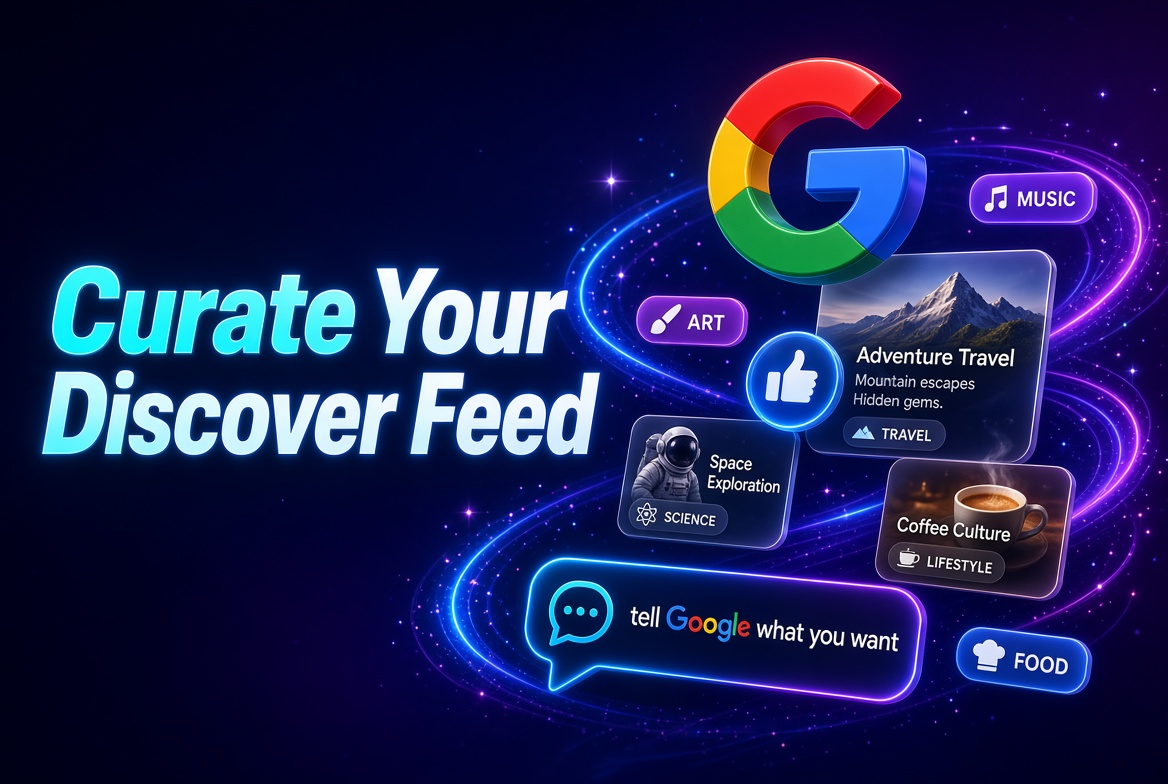
Google Lets Users Tell Discover Exactly What They Want
Google is testing a new way to personalize its Discover feed, allowing users to tell Google directly what kind of content they want to see.
Instead of relying entirely on past searches, clicks and browsing behavior, users can now use natural-language instructions to tell Discover what they want more — or less — of.
For example, a user could ask for:
“Show me more AI and robotics news, but less cryptocurrency.”
Or:
“Show me advanced React and JavaScript tutorials.”
Google’s system can then use those instructions to adjust the content appearing in the user's Discover feed.
A More Direct Way to Control Recommendations
Google Discover has traditionally personalized recommendations by analyzing signals such as a user's interests, searches and interactions with content.
The new “Tailor your feed” experiment takes a different approach: instead of making users manually configure numerous interests, Google lets them describe their preferences in ordinary language.
Users can access the feature from a Discover recommendation and provide instructions about the topics, sources, formats or types of content they prefer.
The goal is to make personalization feel more like having a conversation with the recommendation system rather than configuring a collection of settings.
AI Behind the Personalization
The feature is part of Google's broader push to use AI throughout Search and its recommendation experiences.
Natural-language instructions can express preferences that are difficult to capture with traditional topic-following systems. Someone might not simply want “technology”; they could want AI research, developer tutorials and hardware news while avoiding celebrity technology stories, for example.
Google's system can interpret those instructions and use them when selecting future Discover recommendations.
Google has also experimented with a “You asked to see” label, which can indicate when content appears because of an explicit request from the user.
Preferred Sources Are Also Expanding
The Discover experiment comes alongside Google's efforts to give users more control over where information comes from.
Google has introduced Preferred Sources, allowing users to prioritize particular publishers and sources across parts of Google's information ecosystem.
Together, these changes point toward a broader shift in how recommendation systems work.
Instead of algorithms simply trying to predict what users might like, users could increasingly tell the algorithm what they want directly.
Not Available Everywhere Yet
There is an important catch: Tailor your feed is still an experiment, rather than a universally available Google Discover feature.
Google's Search Labs information currently describes availability as limited, including restrictions around location, language, age and device requirements.
That means many Discover users may not see the feature yet.
If Google eventually rolls it out more broadly, however, it could fundamentally change how people interact with personalized feeds.
The Bigger Picture
For years, recommendation algorithms have largely worked behind the scenes, learning from what people click, watch and search for.
Google's new experiment flips part of that model around.
Instead of the algorithm asking, “What does this person probably want?” users can simply say, “This is what I want.”
And that could be an important step toward making AI-powered recommendation systems more transparent, controllable and personalized.

Hermes Smith